Task 38.1
Essay Writing · Survey Comment
Comment on Data & Give Your Opinion
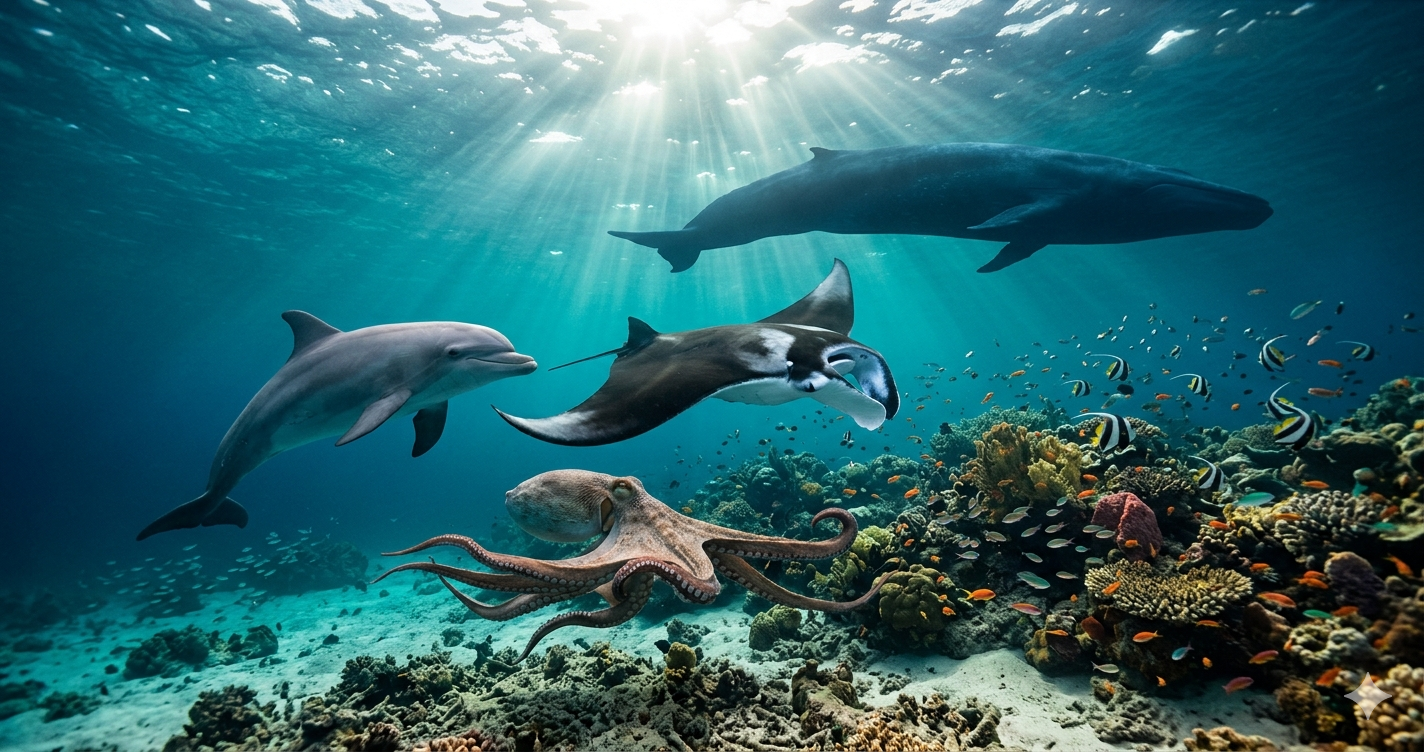
Marine Life — What Do Young Zetlanders Know?
Survey-Based Essay · 200–250 words · 5 Paragraphs
Back to variants
Task 38.1
Imagine that you are doing a project on what young Zetlanders know about marine life. You have found some data on the subject — the results of a survey conducted among young Zetlanders (see the table below).
Comment on the survey data and give your opinion on the subject of the project.
The survey question: What sea creature is the smartest?
Choose one option
| Options | Number of respondents (%) |
|---|---|
| Dolphin | |
| Blue whale | |
| Octopus | |
| Manta ray | |
| Sea lion |
Write 200–250 words. Use the following plan:
- make an opening statement on the subject of the project;
- select and report 2–3 facts;
- make 1–2 comparisons where relevant and give your comments;
- outline a problem that can arise with exploring sea depth and suggest a way of solving it;
- conclude by giving and explaining your opinion on the importance of studying marine life.
Part 1 of 5 — Opening Statement
Introduce the topic. State the subject of your project: what young Zetlanders know about marine life. Mention the survey briefly.
Tap a phrase to insert it:
The oceans cover more than 70% of our planet,
Marine life has always fascinated scientists and the public alike.
A recent survey among young Zetlanders explored
This project focuses on
As part of a project on marine life,
0 words~2–3 sentences
Part 2 of 5 — Key Facts from the Survey
Report 2–3 specific facts from the data. Use percentages from the table. Mention the most and least popular answers.
Facts you can use — pick 2 or 3
42% chose the dolphin — the most popular answer by far.
25% voted for the blue whale — the second most chosen option.
Only 5% picked the sea lion — the least popular choice.
18% selected the octopus, despite its well-documented intelligence.
10% chose the manta ray.
Useful phrases — tap to insert:
According to the survey,
The results show that
The majority of respondents (42%)
Notably,
It is worth mentioning that
At the other end of the scale,
0 words~3–5 sentences
Part 3 of 5 — Comparisons & Comments
Compare 1–2 pairs of results and add your comment. Why might people have chosen one creature over another? Are the results surprising?
Comparison ideas
Dolphin vs. octopus — dolphins are more famous; octopus intelligence is less known to the public.
Blue whale vs. manta ray — both large, but the whale is far more familiar from media.
Top result vs. bottom — gap between dolphin (42%) and sea lion (5%) is striking.
Comparison starters — tap to insert:
Compared to the dolphin,
While dolphins received 42%,
This is perhaps because
In contrast,
Interestingly,
It seems that media representation plays a role,
0 words~3–4 sentences
Part 4 of 5 — Problem & Solution
Outline a problem with exploring sea depth and suggest a realistic way to solve it.
Problem & solution ideas
Problem: extreme pressure at great depth makes it impossible for humans to dive there safely.
Problem: lack of light in the deep ocean limits observation and research.
Problem: deep-sea exploration is extremely expensive and requires specialised equipment.
Solution: develop advanced remote-operated vehicles (ROVs) and autonomous drones.
Solution: international funding and cooperation between research institutions.
Problem / solution phrases — tap to insert:
One major challenge is
A significant problem with
However, this could be solved by
One possible solution would be
To overcome this,
Thanks to modern technology,
0 words~3–4 sentences
Part 5 of 5 — Conclusion
Give and explain your opinion on the importance of studying marine life. Why does it matter? What could we gain?
Closing phrases — tap to insert:
In conclusion,
To sum up,
I strongly believe that
In my opinion, studying marine life is crucial because
Understanding the ocean is essential for
Without further research,
0 words~2–4 sentences
Vocabulary — key words & phrases